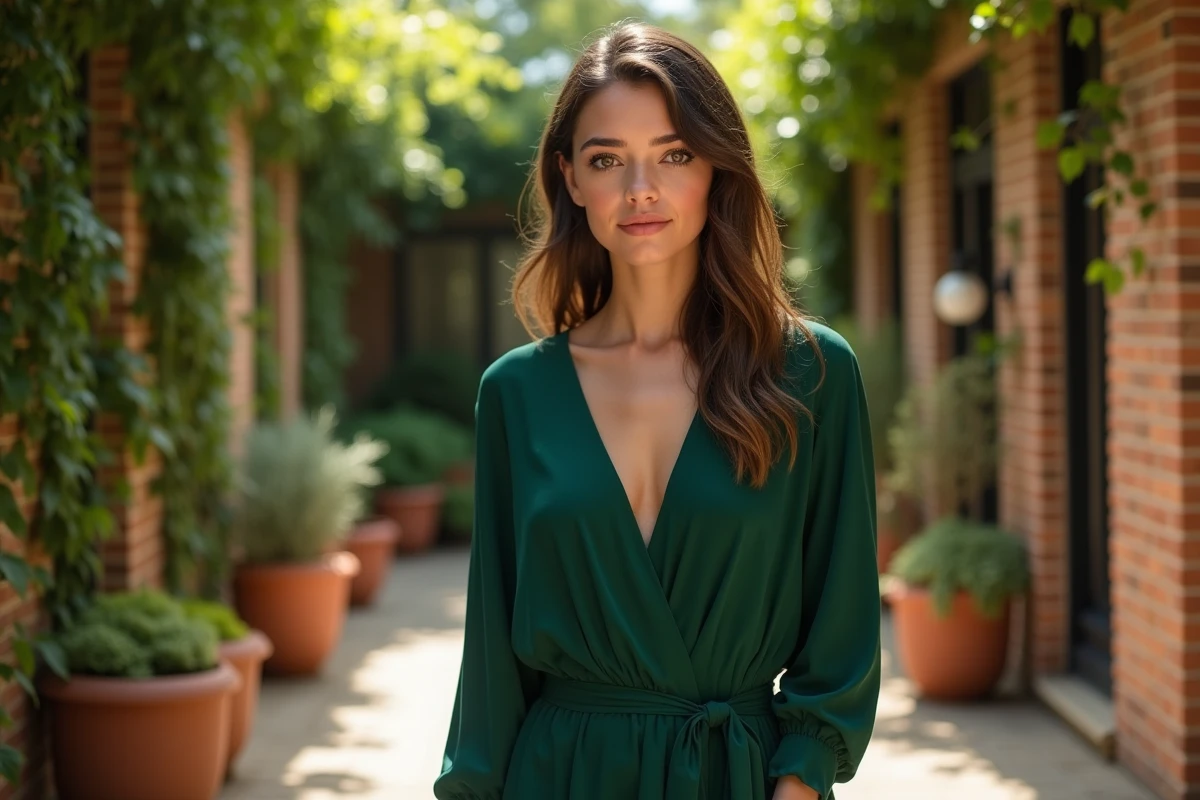
You are wearing an olive green sweater and your eyes lean towards golden. The next day, with a light gray top, it is the brown tones that dominate. This phenomenon is no illusion: hazel eyes react to surrounding colors more than any other iris shade. Understanding this mechanism allows you to choose clothing that directs attention to the hue you prefer to highlight.
Why hazel eyes change color depending on clothing
The hazel iris mixes brown, green, and golden pigments in varying proportions. The light bouncing off a colored fabric near the face alters the dominant wavelength perceived by the observer. A terracotta turtleneck reflects warm waves towards the iris: the golden and amber highlights stand out. A navy blouse, on the other hand, brings the green tones to the forefront.
This principle is called metamerism applied to clothing. Two people with hazel eyes will not see the same effect with the same color, because the proportion of green, brown, and gold varies from one iris to another. Before building a targeted wardrobe, observe your eyes in natural light in front of a mirror, successively placing a warm fabric (rust, camel) and then a cool fabric (blue, plum) under your chin. The dominant hue that emerges indicates your color family.
To delve deeper into the associations that enhance the color of hazel eyes, this initial spotting is the most reliable starting point.
Clothing colors for hazel eyes: combinations that work
You may have noticed that the same top can look dull in a photo and vibrant in person? The reason often lies in the contrast between the saturation of the fabric and the clarity of the iris. Here are the color families that produce a visible effect on most hazel irises.

Warm tones to awaken golden highlights
Terracotta, copper, and burgundy amplify the amber component of the iris. These shades share an orange or red undertone that acts like a mirror for the golden flecks present in hazel eyes. A copper knit sweater or a burgundy blazer produces an immediate effect, even under office lighting.
Camel and bronze work in the same register, with a more discreet result. They are better suited for professional contexts where overly saturated colors might seem out of place.
Cool tones to bring out the green
If your iris leans towards green, cool shades create an effective complementary contrast. Navy blue and plum highlight the green tones of the hazel iris. A cobalt blue blouse, for example, pushes the green pigments to the forefront of the perceived spectrum.
Deep purple and teal produce a similar result. Be cautious with medium gray and overly neutral beige, which tend to “wash out” the iris by not reflecting any marked wavelength.
- Dominant golden highlights: favor terracotta, copper, burgundy, and camel to intensify the warmth of the iris.
- Dominant green highlights: lean towards navy blue, plum, teal, or deep purple to create a complementary contrast.
- Very mixed iris (equal parts green and gold): dark khaki and bronze play on both registers simultaneously.
Adapting clothing color to lighting and context
Choosing a flattering shade is not enough if you don’t know in what light you will be seen. A perfect burgundy in natural light can turn into a dull brown under office neon. This shift, linked to the color temperature of the light source, radically changes the interaction between the fabric and the iris.

Natural light and outdoor outings
Daylight, around neutral temperature, faithfully reproduces colors. This is the most permissive context: almost all warm and cool shades work in broad daylight. Take advantage of this to wear saturated colors (bright copper, cobalt blue) that would lose their brilliance indoors.
Office neon and video calls
Neons emit cold, bluish light. As a result, lightly saturated warm shades (light camel, golden beige) appear washed out, and the hazel iris loses its amber highlights. Under this lighting, a deep burgundy or a rich bronze holds up better than camel. In video calls, the webcam compresses colors: opt for a strong contrast between the top and the skin. A solid navy blue, without patterns, gives a clear rendering on screen while highlighting the green tones.
Dimming lighting and evenings
Warm bulbs (like tungsten) saturate orange and golden tones. A copper top that seemed subtle in the store can become very heavy in the evening. Favor plum or navy blue, whose depth absorbs excess ambient warmth. The iris then captures just enough warm light to reveal its golden flecks without the clothing stealing the spotlight.
Common color mistakes with hazel eyes
Some associations often recur and produce the opposite effect of what is sought. Total black, worn close to the face, creates such a harsh contrast that the iris appears duller. A black turtleneck absorbs light without reflecting anything back to the eyes. Replacing black with a very dark blue changes the game: the contrast remains, but the iris receives a complementary reflection.
Pure white poses a different problem. It reflects all wavelengths equally and “drowns” the subtleties of the hazel iris. An off-white or a warm white directs light better.
- Pure black in a turtleneck or crew neck: replace with navy blue or anthracite.
- Optical white: swap for an off-white, ivory, or warm off-white with warm undertones.
- Neutral medium gray: too flat to interact with the iris. Prefer a bluish gray or taupe gray.
The most common trap remains choosing your color in-store under lighting that does not match the intended use. Bring the garment near a window or use your phone’s camera to simulate lighting similar to that in which you will wear it. Testing the color in the right light avoids most disappointments.